
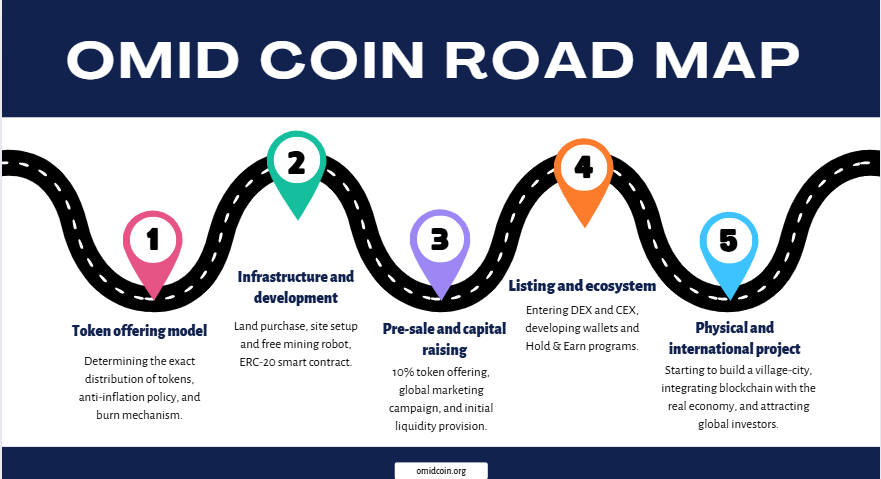
Roadmap of omid coin
Click on the heading title to review each section.
Token supply model and economy
Introduction
Omidcoin’s economic model is designed to create a transparent, sustainable, and community-driven structure. By combining a gradual and controlled supply through a limited pre-sale and smart Proof-of-Activity mining, it maintains a balance between sustainable development, inflation control, and user incentivization.
In this structure, the development team is trying to make OMC one of the most stable digital assets on the Polygon platform, focusing on long-term resource management and increasing the intrinsic value of the token.
Case 1. Supply model objectives
* Maintain price stability and prevent sudden inflation
* Fair and community-oriented distribution
* Provide support for the development of sustainable infrastructure and projects
* Provide real incentives for users and long-term investors
Second item: Total supply and distribution structure (Distribution Plan)
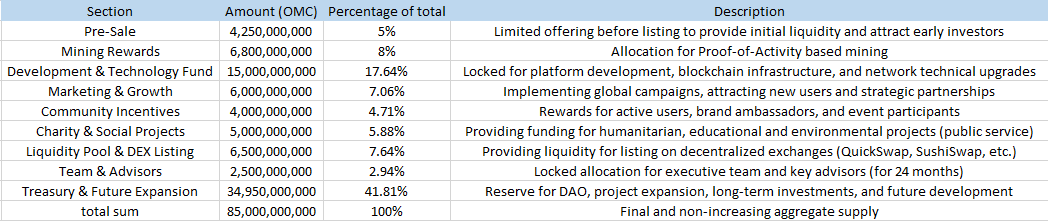
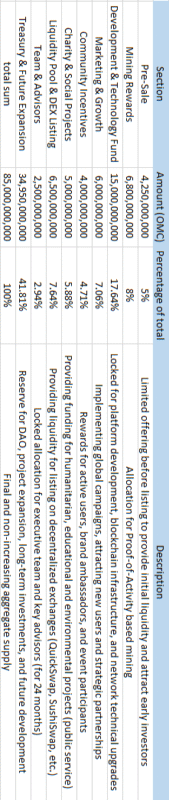
Please rotate your mobile phone if the table above is illegible.
Case 3. Mining Mechanism
The Omid Coin (OMC) mining system is designed in a hybrid, two-stage manner so that both ordinary users can mine tokens through simple interaction on the site, and more active individuals in the ecosystem can receive rewards through social participation.
This structure enables fair and true token distribution without the need for hardware equipment or technical knowledge.
🔹 First model: Mining via a website click-to-Mine Bot
This model is available through a dedicated mining robot on the official Omidcoin website. By logging into their account, users can mine tokens by performing manual clicks at specific time intervals.
The click system is designed based on the Proof of Click & Activity algorithm, meaning that each valid click is recorded as a sign of real user participation and its reward is calculated.
Features of the click model:
- Annual mining capacity: 1,700,000,000 OMC
- Project implementation period: 4 years (total 6.8 billion OMC)
- Requires manual click by user (no auto-run)
- Anti-fraud control and recording of valid clicks through the authentication system
- Automatic deposit of rewards into the wallet connected to the user’s account at the end of each period
This method allows users to earn a portion of the network mining and share in the profits of the token’s growth with the simplest possible action (clicking on the official site).
🔹 Second model: Community Activity Rewards
Alongside the clicker bot, 4 billion tokens are also allocated to active users in the Omidcoin ecosystem. This section is designed to encourage real participation in the project and operates through the Proof of Activity (PoA) algorithm.
Activities that include rewards:
- Long-term token holding in a personal wallet
- Performing on-chain transactions on the Polygon network
- Participation in events, charity campaigns, and social projects of hope
- Inviting new users through the official referral system
Specifications of the second model:
- Total capacity: 4,000,000,000 OMC
- Distribution period: 4 years
- Paying rewards on-chain via smart contract
- Complete transparency of transactions in PolygonScan
🔸 جمعبندی مدل ماینینگ
Omidcoin’s mining model combines Click-to-Mine and Proof-of-Activity (PoA) structures to provide a unique, fair, fun, and transparent mining experience.
In total:
- Total mining share: 6.8 billion (clicks) + 4 billion (activity) = 10.8 billion OMC
- Total period: 4 years (from 2026 to 2030)
- کاهش پاداش سالانه (Halving) برای حفظ ارزش بلندمدت
- Full recording of transactions and rewards on the Polygon blockchain
Fourth item: Pre-Sale & Launch Strategy
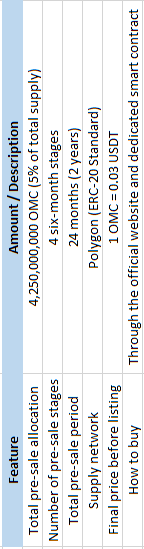
In order to provide initial liquidity, develop infrastructure, and expand the user community, 5% of the total supply (4,250,000,000 OMC) will be offered in a public pre-sale and phased over two years (from 2026 to 2028).
This phased structure helps balance the price, attract genuine investors, and prevent extreme volatility in the primary market.
🔹 General pre-sale details
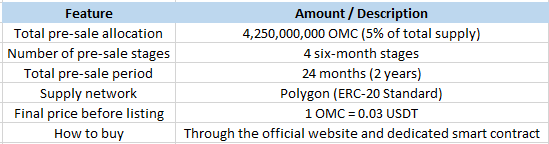
🔸 Pricing structure and schedule of steps


Please rotate your mobile phone if the table above is illegible.
💰 Use of collected funds


🔸 Post-presale path
After the completion of the fourth phase of the pre-sale, the listing process on decentralized exchanges (DEX) will begin and the token will be listed on QuickSwap first. In the next stages, the listing program will be implemented on international centralized exchanges (CEX).
All pre-sale transactions and allocations will be visible and traceable via a verified smart contract in PolygonScan.
Item 5. Security and Transparency Features
* Time-Lock: Team, Treasury, and Development tokens are locked for at least 24 months.
* Burn Mechanism: 0.5% of each transaction is sent to an irreversible address.
* Audited Smart Contract: The smart contract is audited by reputable international companies such as CertiK.
*Anti-Whale Protection: Limiting transaction volume to prevent concentration of power.
*PolygonScan Verification: The contract address, logo, and official site link have been registered and verified.
Item 6. Wallets and public acceptance
- Wallet Integration: Supports MetaMask, Trust Wallet, Coinbase Wallet, and TokenPocket
- DEX Listings: Liquidity pool on QuickSwap, then SushiSwap and Uniswap
- CMC & CoinGecko Listing: Official Registration Information and Whitepaper
- Community Incentives: Hold & Earn campaigns for early adopters
- Partnerships: Collaboration with DeFi and NFT projects on the Polygon network
Item 7. Economic Goals & Inflation Control
The Omid Coin (OMC) offering model is designed to ensure that the actual market offering is only through stable and controlled channels.
These three channels include pre-sale in the first two years, click-through mining, and active user rewards.
The main goal is to create a balance between community growth, increasing token value, and preventing premature inflation.
📊 Omidcoin (OMC) Annual Active Supply Table


🔸 Sustainability policies and supply control
*Annual Halving of Rewards: The mining reward rate and user activity gradually decrease each year.
*Burn Mechanism: 0.5% of each transaction is burned to prevent inflation.
*Team and Development Lockdown: Team tokens, treasury, and future projects will be locked for 24 months.
*Smart liquidity management: Tokens are released on DEXs only in proportion to the actual market volume.
🪙 Economic conclusion
This delivery model allows for:
- The volume of tokens in circulation should grow naturally and logically.
- The market is safe from sudden supply pressure.
- The intrinsic value of OMC will increase over time.
In this way, Omid Coin (OMC) will be the founder of a new model of activity-based tokens and sustainable development on the Polygon platform, with a transparent, gradual, and community-oriented economy.
Item Eight: Technical-economic characteristics at a glance


Item 9. Conclusion
The Hope Coin token economy is a combination of economic engineering, supply discipline, and commitment to social goals.
With a controlled supply model, strong treasury support, and activity-based reward system, OMC is on track to become a stable, transparent, and community-driven digital asset.
Phase 1 – Token Preparation and Development
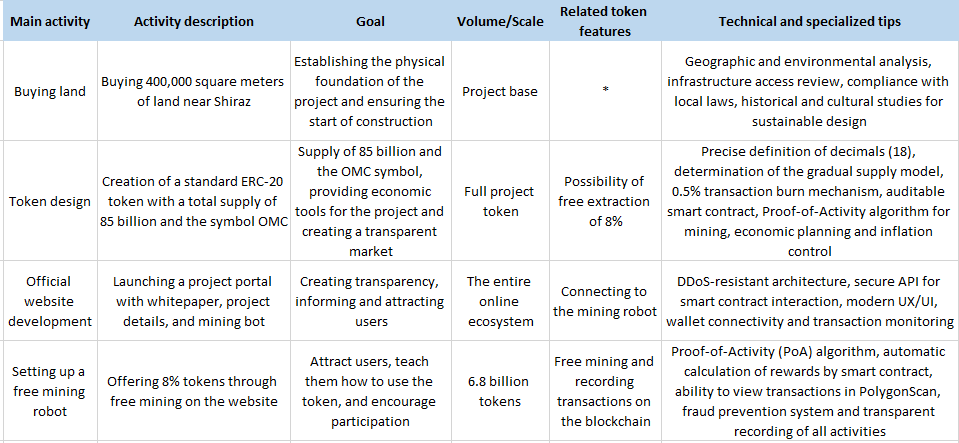
Table of activities and goals of the first phase
Please rotate your mobile phone if the table above is illegible.
Comprehensive and professional explanatory text for the first phase
The first phase of the OMC roadmap is the foundation and cornerstone of the entire project and aims to create physical, economic and digital infrastructure simultaneously. This phase is of particular importance because all subsequent stages of the project are planned based on the success and quality of implementation of this phase.
Case 1. Physical basis of the project: land purchase
In this phase, Shiraz Youth Hope Holding has purchased 400,000 square meters of land in a pleasant and historical area near Shiraz. This land is intended to serve as the physical foundation of the largest modern and sustainable village-city in Iran and the world.
To ensure the success of the project, comprehensive studies have been conducted, including:
- Geographical and environmental analysis: ensuring the project is compatible with the region’s climatic and environmental conditions
- Infrastructure review: access to electricity, water, internet, transportation, and public facilities
- Historical and cultural studies: preserving local values and creating sustainable and socially responsible design
These measures will make the project not only physically sustainable, but also socially and culturally acceptable and attractive to investors and tourists.
Second case: OMC token design
While preparing the physical base, the development team has designed an ERC-20 standard token with a total supply of 85 billion and the symbol OMC. This token has the following features:
- Standard 18 Decimals for transaction accuracy
- Gradual and combined supply model (Pre-Sale + Mining) to control inflation and price stability
- Burn mechanism of 0.5% of transactions to increase the intrinsic value of the token
- Free mining bot with Proof-of-Activity (PoA) algorithm that makes 8% of all tokens available to users
- Auditable smart contract to ensure security and transparency
The token design is focused on smart economics, transaction transparency, and fairness in distribution, and is planned in such a way that, in addition to attracting early users, large investors are also assured of the stability and value of the token.
Case 3: Website development and digital infrastructure
To introduce the project and provide transparent access, an official project website has been launched. This site includes:
- Whitepaper and full project details
- User portal and token mining dashboard
- Secure connection to mining bots and wallets
- DDoS-resistant architecture and advanced cybersecurity
- Secure API for interacting with smart contracts and recording transactions
This digital infrastructure builds trust among the community and international users and provides the necessary foundation for token pre-sale and listing.
Fourth item: Launching a free mining robot
One of the key features of the first phase is the free OMC mining bot, which allows users to mine 8% of the total tokens (6.8 billion) via Proof-of-Activity (PoA).
Technical features of the robot:
- Automatic calculation of rewards by smart contract
- Recording all transactions and activities on the Polygon network
- Ability to view transactions via PolygonScan
- Fraud prevention and user activity validation system
- Encouraging users to actively participate and hold tokens
This mechanism creates an active community, increases user familiarity with the token, and prepares the market for pre-sale and listing.
Fifth item: General objectives of the first phase
- Creating the project’s economic, digital and physical infrastructure
- Ensuring transparency, security, and fairness in token distribution
- Preparing the project for pre-sale, listing, and the start of physical construction
- Attracting early users and creating an active and participatory community
Phase 2 – Token Pre-Sale and Capital Raising
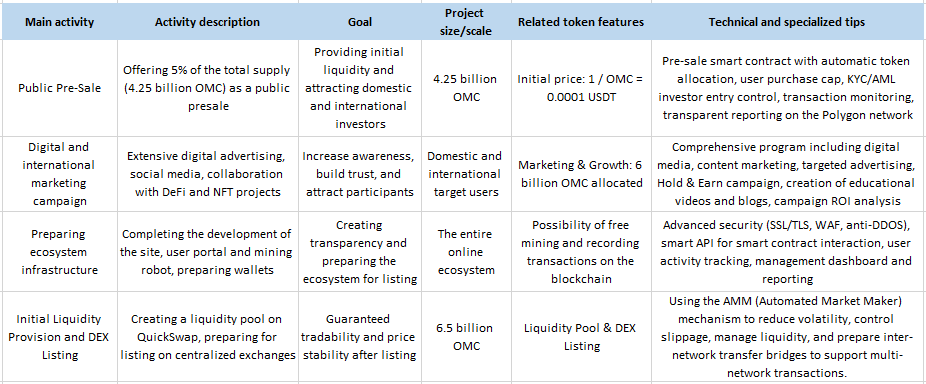
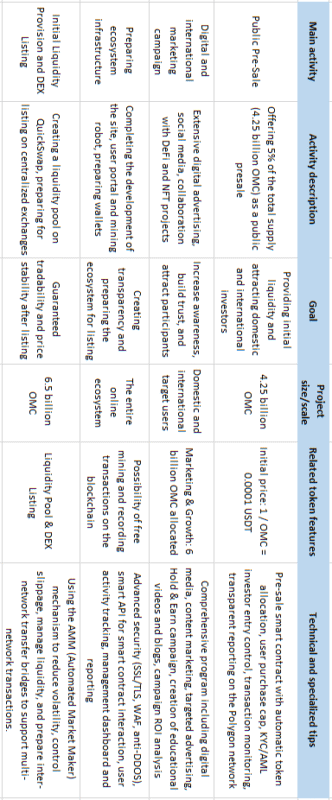
Table of activities and goals of the second phase
Please rotate your mobile phone if the table above is illegible.
Comprehensive and professional explanatory text for the second phase
The second phase of the OMC roadmap is a key and critical step to prepare the market, attract investors, and build a sustainable financial infrastructure and ecosystem. It will begin after the successful completion of the first phase and will focus on the token pre-sale, international marketing, infrastructure preparation, and initial liquidity.
First Case: Public Pre-Sale
At this stage, 5% of the total token supply (4.25 billion OMC) will be offered through a public presale. The presale is a milestone for:
- Providing initial liquidity for the project
- Attracting large domestic and international investors
- Creating an active and transparent primary market for tokens
Technical and economic features of pre-sale:
*Pre-sale smart contract: automatic distribution of tokens, purchase cap per user, and KYC/AML compliance
*Transparency and traceability of transactions: All transactions are recorded on the Polygon network and can be viewed through PolygonScan
*Supply control and price stability: Limited pre-sale supply to prevent selling pressure and extreme fluctuations
*Financial security: Transactions and funds are reviewed and approved by the smart contract development and auditing team
Case 2. Digital and international marketing campaign
Pre-sale success requires a professional marketing campaign that is implemented simultaneously on several levels:
- Digital Marketing: Targeted advertising on social networks, Google Ads, and specialized blockchain media
- Collaboration with DeFi and NFT projects: increasing credibility and attracting a target community active in blockchain
- Hold & Earn Campaign: Encouraging users to hold tokens and participate in the ecosystem
- Content production and education: Publishing educational videos, blogs, and market analysis reports to increase transparency and trust.
- Analysis and reporting: Review ROI indicators, user engagement, and the impact of campaigns on community growth
This program will help OMC become quickly recognized and create an active and participatory community.
Third item: Preparing ecosystem infrastructure
The second phase of digital infrastructure includes:
*User site and portal: secure access, modern UX/UI, transaction monitoring dashboard
*Free mining bot: Allows users to continue mining 8% of all tokens
*Connect to wallets: MetaMask, Trust Wallet, Coinbase Wallet and TokenPocket
*Advanced cybersecurity: SSL/TLS, WAF, anti-DDoS, access management and secure API
*Management dashboard: Ability to monitor user activity, financial and economic reporting
These measures ensure that the ecosystem is ready for user and investor engagement for the next stages.
Fourth item: Initial liquidity provision and DEX Listing
After the pre-sale, 6.5 billion OMC will be allocated to the liquidity pool on QuickSwap to:
- Enable fast and stable token trading
- The token price is under control and extreme volatility is reduced.
- Preparing for listing on centralized exchanges and inter-network transfer bridges
Technical features:
- Using AMM (Automated Market Maker) for Liquidity Management
- Set slippage and minimum transactions to prevent price fluctuations
- Intelligent liquidity management and market behavior analysis
Fifth item: General objectives of the second phase
- Creating an active and transparent market for tokens
- Attracting domestic and international investors
- Preparing digital and financial infrastructure for listing and public acceptance
- Increasing user participation and creating an active and participatory community
- Ensuring transparency, security and economic sustainability of the project
Phase 3 – Token Listing and Ecosystem Development
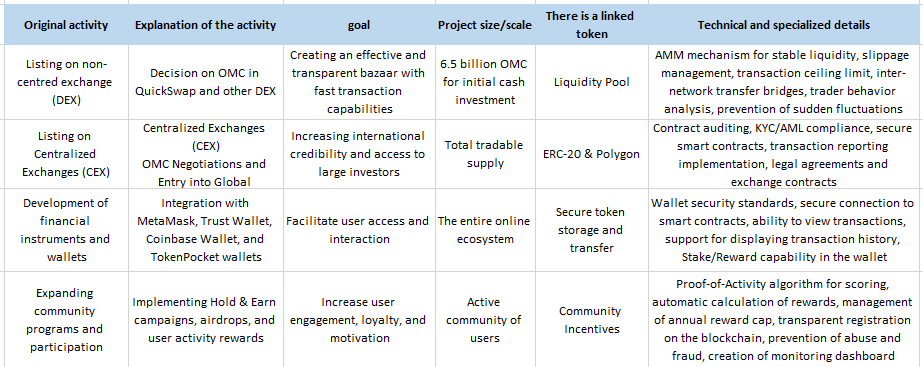
Table of activities and goals of the third phase
Please rotate your mobile phone if the table above is illegible.
Professional explanatory text for Phase 3 with technical details
The third phase of the OMC roadmap is a milestone for the project, as it includes listing the token on exchanges, developing the trading infrastructure, and expanding the active user community. This phase is key to the project’s entry into the global market and increasing engagement with the international community.
Case 1. Listing on Decentralized Exchanges (DEX)
After the pre-sale and initial liquidity, the OMC token will be listed on DEXs such as QuickSwap.
Advanced technical features:
*AMM (Automated Market Maker) mechanism: The liquidity pool automatically manages transactions and reduces price fluctuations.
*Slippage Management: Limits the price change between order and execution to protect users on large trades.
*Transaction cap control: Preventing large investors (whales) from entering to maintain fair token distribution.
*Inter-network transfer bridges: Ability to transfer tokens between Polygon and other partner networks, increasing transaction flexibility.
*Market Behavior Analysis: Real-time monitoring of trading volume, user activity, and pool liquidity to predict market trends and prevent sudden fluctuations.
These measures ensure that the token market is active, transparent, and stable, providing a seamless user experience.
Case 2. Listing on Centralized Exchanges (CEX)
After stabilizing the market on DEX, OMC enters international centralized exchanges to:
- The international credibility of the token will increase.
- Large investors and financial institutions gain access to the project
- Increase trading volume and create stable liquidity
Technical and legal features:
*Contract Audit: Complete smart contract review to prevent security errors
*KYC/AML standard: Verifying the identity of investors to comply with international laws
*Transparent reporting: Ability to view transactions by investors and the development team
*Legal agreements: Formal contracts with the exchange to ensure the security of users’ funds
Case 3. Development of financial instruments and wallets
To ensure secure user access:
- Integration with trusted wallets MetaMask, Trust Wallet, Coinbase Wallet, and TokenPocket
- Ability to securely store, transfer, and view transactions
- Support for Stake and Reward within the wallet to increase user engagement
- Transaction management dashboard to analyze user behavior and review rewards
Fourth item: Expanding community programs and participation
The success of the project is not possible without an active and participatory community. Key actions:
*Hold & Earn: Encourage users to hold tokens and participate in the ecosystem
*Airdrops and user activity rewards: Rewards for participating in campaigns and interacting with the project
*Proof-of-Activity: Advanced algorithm for accurate scoring and reward allocation
*Transparency and security: Record all rewards on the blockchain, preventing fraud and abuse
*Monitoring dashboard: Monitor and manage community activity, analyze behavior, and create analytical reports
Item 5. Key objectives of the third phase
- Creating an active and stable market on DEX and CEX
- Increasing the token’s international reach and credibility
- Development of financial infrastructure and wallets
- Increase community engagement and user loyalty
- Ensuring the security, transparency and economic stability of the project
Phase 4 – Physical Project Expansion and International Ecosystem Development
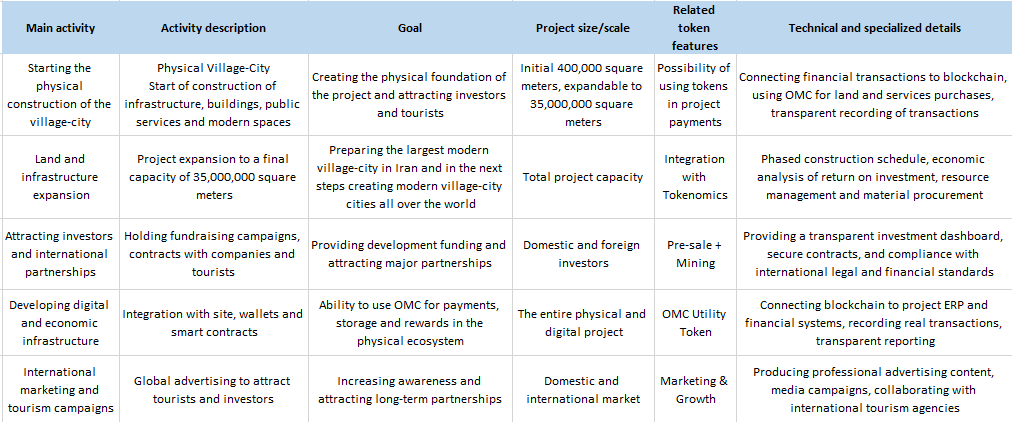
Professional explanatory text, phase four
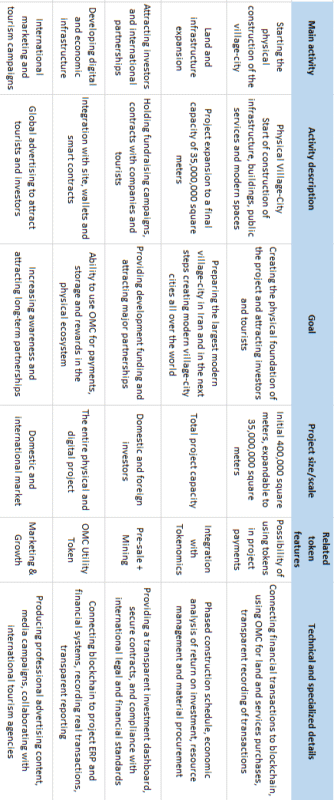
Please rotate your mobile phone if the table above is illegible.
The fourth phase of the OMC roadmap is the turning point of the project, as it begins to establish the physical and operational foundation of the Village-City project, while simultaneously expanding the economic and digital infrastructure. This phase ensures that OMC is not just a digital token, but a real tool in the project economy.
First case: Starting the physical construction of the village-city
- Construction of infrastructure, including modern buildings, public services, cultural and tourism spaces
- Using OMC to pay for services, purchase land, and facilitate transactions
- All transactions are transparently recorded on the blockchain to maintain the trust of investors and users.
Second: Land and infrastructure expansion
- Project expansion from initial 400,000 square meters to final capacity of 35,000,000 square meters
- Phased construction scheduling with resource management, economic analysis, and return on investment
- Possibility of developing new phases, creating commercial, residential and recreational areas
Third item: Attracting investors and international participation
- Providing investment opportunities with complete transparency, financial dashboards, and secure contracts
- Focus on large investors and international tourists
- Attracting partnerships for side projects such as cultural, recreational, and tourism centers
Fourth item: Developing digital and economic infrastructure
- Connecting OMC to project ERP and financial systems
- Ability to use tokens for payment, storage and rewards within the village-city
- Recording and tracking all transactions on the blockchain for economic transparency and investor trust
Item 5. International marketing and tourism campaigns
- Global advertising to attract tourists, investors, and ecosystem participants
- Professional content production, media campaigns and cooperation with international tourism agencies
- Focus on creating credibility and branding the project as the largest modern village-city in the world
Item 6. Key objectives of the fourth phase
- Completing the project’s physical foundation and economic and digital infrastructure
- Expanding land to 35,000,000 square meters and preparing the project for long-term development
- Practical use of OMC in real project economics
- Attracting large investors and international tourists
- Ensuring the transparency, security and economic sustainability of the project


