
White Paper
Everything you need to know about Omid Kevin
White Letter of omid
By clicking on any of the headings below, you will go directly to the page for that heading.
*
Blockchain is one of the greatest technological innovations of the 21st century, redefining the concept of trust, ownership, and data transfer in the digital world. In its simplest form, blockchain is a distributed ledger that stores data and transactions in a chain of blocks across a set of nodes, which collectively verify and guarantee the authenticity of the data without the need for intermediaries.
Unlike traditional databases that are controlled by a central organization, blockchain is decentralized. This means that no single entity has the ability to change or delete data. Each block in the chain contains a set of transactions, a timestamp, and a cryptographic hash of the previous block. This chain connection makes any unauthorized changes immediately detectable and computationally nearly impossible.
🔹 Technical structure of blockchain
Every blockchain consists of three main components:
Blocks: Contains a collection of transactions and information related to the state of the network.
Chain: An encrypted connection between blocks that is established by the hash of each previous block.
Nodes: Computers that maintain a copy of the ledger and ensure the accuracy of the data by implementing a consensus protocol.
Transactions on the blockchain are validated when a majority of nodes agree that they are correct. This process is accomplished by various consensus algorithms such as Proof of Work (PoW), Proof of Stake (PoS), or more advanced versions thereof.
🔹 Key features of blockchain
Decentralization: There is no central control over the data.
High security: The use of asymmetric encryption and hashing makes it almost impossible to alter data.
Transparency: All transactions are public and auditable.
Immutability: Once a transaction is recorded, it cannot be deleted or edited.
Programmability: In networks like Ethereum or Polygon, smart contracts can be used to automatically execute rules.
These features have made blockchain a revolutionary infrastructure for decentralized finance (DeFi), non-fungible tokens (NFTs), decentralized autonomous organizations (DAOs), and even digital voting.
Polygon Blockchain
Polygon, formerly known as Matic Network, is one of the most advanced and widely used Ethereum-compatible networks. It is designed to address the main limitations of the Ethereum blockchain – low scalability, high transaction costs, and long confirmation times.
Polygon can be described as a Layer-2 Scaling Solution for Ethereum. This means that instead of creating a separate, independent network, Polygon builds on Ethereum’s security and infrastructure, but uses its own technologies to increase speed and efficiency.
🔹 Polygon Network Architecture
The Polygon network consists of several separate layers, each of which has a specific task:
Ethereum Layer: This layer takes advantage of Ethereum’s security and decentralization and periodically records transactions and contracts on the main Ethereum blockchain.
Security Layer: A set of independent validators that strengthen network security through consensus mechanisms.
Polygon Networks Layer: In this layer, multiple sidechains can run independently and host smart contracts and DApps.
Execution Layer: Responsible for processing transactions and executing smart contracts at high speed and low cost.
This multi-layered structure makes Polygon fast, scalable, and secure with Ethereum.
🔹 Polygon’s main technologies and benefits
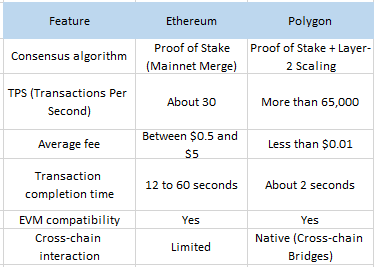
High speed: Polygon can process up to 65,000 transactions per second (TPS) per chain, while Ethereum has around 15 TPS.
Very low fees: Due to the optimized architecture, the fee per transaction is usually less than a few hundred dollars.
Full compatibility with EVM (Ethereum Virtual Machine): Due to EVM support, Ethereum developers can deploy their DApps on Polygon without making any major code changes.
High flexibility: It is possible to build independent or dependent chains on Ethereum security.
Supports multiple scalability solutions: including Plasma, zk-Rollups, Optimistic Rollups, and Validium.
🔹 Polygon’s role in the blockchain ecosystem
Polygon is one of the few projects that has managed to bridge the gap between scalability and decentralization. Many prominent DeFi, GameFi, and NFT projects have chosen to use the Polygon network in recent years instead of deploying directly on Ethereum. These include:
Aave
QuickSwap
Decentraland
OpenSea (in the Polygon NFTs section)
These choices are due to the unique combination of speed, low cost, and security shared with Ethereum.
🔹 The importance of Polygon for OmidCoin
Choosing Polygon Network to create the OmidCoin token was a strategic and conscious decision. On the one hand, the network minimizes transaction costs and time with its powerful infrastructure, and on the other hand, due to its full compatibility with the ERC-20 standard, it makes it easy to access Ethereum wallets, exchanges, and analytics tools.
Furthermore, Polygon is an ideal environment for projects that seek stability, speed, and a better user experience. Leveraging Polygon’s technology, the OmidCoin token will be able to offer fast, secure, and cost-effective transactions, providing a solid foundation for the development of the OmidCoin ecosystem — whether in the field of micropayments, NFTs, or the project’s future social activities.
🔹 The future of Polygon
Polygon is constantly evolving. The network is now moving towards Polygon 2.0 — a version built on zk-EVM (Zero-Knowledge Ethereum Virtual Machine) technology that aims to create the infrastructure for an “Internet of Value Chains.” In this architecture, each Polygon chain will be natively interoperable with other chains, and users will be able to move their assets between chains without the need for intermediaries.
For projects like OmidCoin, this prospect means unlimited growth, as it can easily interact between different chains in the future, without requiring users to have complex technical knowledge.
🔹 Conclusion
In a world where transparency, security, and digital independence are increasingly important, blockchain has become the backbone of the modern economy. Polygon is not only one of the most stable and fastest blockchain networks, but also a bridge between the future and the present of the Web3 world.
Deploying OmidCoin on the Polygon platform is a decision based on science and foresight, as the network offers a unique combination of Ethereum security, high speed, low fees, and a smooth user experience.
In fulfilling HopeCoin’s mission—to create value and motivation in a decentralized ecosystem—Polygon’s blockchain will play a fundamental and strategic role.
.
*
Understanding how blockchain works is key to understanding why this technology is so revolutionary and reliable. Blockchain is not just a digital ledger, but a cryptographic, self-regulating, distributed system that keeps data globally consistent and valid without the need for a central authority.
🔹 1. The internal structure of the blockchain
Each blockchain is a collection of blocks that are connected together in a chain. Each block consists of three main components:
- Transaction Data: Information related to the transfer of value or the execution of smart contracts.
- Previous Block Hash: The digital signature of the previous block that establishes the connection between blocks.
- Transaction Data: Information related to the transfer of value or the execution of smart contracts.
As soon as a new block is added to the chain, all nodes in the network verify and verify it. Since each block is linked to the hash of the previous block, a change to one block invalidates the entire chain after it; therefore, the blockchain is virtually immutable.
🔹 2. The role of nodes and the peer-to-peer network (P2P)
The blockchain network is built on direct connections between thousands of nodes around the world. Each node maintains a copy of the entire blockchain and operates independently of other nodes.
When a new transaction is created, it is broadcasted encrypted to all nodes. The nodes then verify the transaction’s validity through a consensus mechanism.
This process ensures that no central entity can change the data, as a majority of nodes must agree to any change. This is the concept of true decentralization.
🔹 ۳. Consensus Mechanism
The beating heart of any blockchain network is its consensus mechanism — the way nodes decide which transactions are valid and which are not.
In traditional systems such as banks, transaction validation is performed by a central entity; however, in blockchain, nodes perform this task collectively through a consensus algorithm.
The most common consensus methods are:
- Proof of Work (PoW): Miners spend a lot of computing power and energy solving cryptographic equations to produce the next block (like Bitcoin).
- Proof of Stake (PoS): Validators use their locked assets (Stake) to participate in consensus, rather than computing power. The higher the stake, the higher the probability of being selected to validate transactions.
🔹 4. How to make a transaction on the blockchain
The process of recording a new transaction on the blockchain is carried out in several steps:
- Transaction creation: The user signs a digital transaction using their private key.
- Send to network: The transaction is sent to all nodes in the network.
- Validation: Nodes check whether the user has sufficient balance and whether the signature is valid.
- Inclusion in block: Valid transactions are collected into a new block.
- Adding a block to the chain: After confirmation by the consensus mechanism, the block is added to the chain.
- Final confirmation: All nodes update their version of the ledger.
On average, in networks like Bitcoin, this process can take several minutes, while in modern networks like Polygon, this time has been reduced to a few seconds.
How the Polygon blockchain works
Polygon is one of the most sophisticated yet efficient blockchain infrastructures in the world. The network uses a combination of Layer 2 Scaling technologies, a Proof-of-Stake (PoS) consensus algorithm, and a multi-chain system to balance speed, security, and decentralization.
🔹 1. Polygon Multi-Layer Architecture
Polygon consists of several separate layers that work together to process transactions with very high efficiency:
- Ethereum Layer
This layer acts as the base layer and leverages the inherent security of the Ethereum blockchain. All key data and security hashes are ultimately stored on Ethereum to ensure absolute immutability.
- Security Layer
This section includes a set of dedicated validators that periodically transmit and verify transactions from the Polygon chain to Ethereum. This greatly increases the security of the second layer.
- Polygon Networks Layer
In this section, different chains (Sidechains) are created that can host different projects and DApps. Each chain has its own rules, parameters, and native token, but interacts with other chains and with Ethereum through the Polygon protocol.
- Execution Layer
At this layer, smart contracts are executed and transactions are processed using the Ethereum Virtual Machine (EVM). Full compatibility with the EVM allows developers to run their Ethereum projects on Polygon without major code changes.
🔹 2. The transaction execution process in Polygon
The process of executing a transaction on the Polygon network involves several technical steps:
- Creating a transaction at the user layer: The user sends the transaction via a wallet (such as MetaMask).
- Sending to Validators: The transaction enters the Mempool and awaits selection for inclusion in the next block.
- Validation by PoS algorithm: Validators who have locked a certain amount of MATIC tokens verify transactions and create new blocks.
- Adding a block to the Polygon chain: The verified block is added to the chain, resulting in a final transaction.
- Checkpoints to Ethereum: At certain intervals, a summary of Polygon transactions (Checkpoint) is sent and recorded to the Ethereum blockchain to ensure ultimate security.
🔹 3. Consensus algorithm in Polygon
Polygon uses Proof of Stake (PoS) where validators lock up their MATIC tokens as collateral. The higher the stake, the more likely that validator is chosen to create a block.
A unique feature of PoS in Polygon is Delegated Staking. Regular users (Delegators) can also delegate their tokens to validators to share in the rewards. In addition to further decentralization, this model creates a strong economic incentive to maintain the health of the network.
🔹 4. Interaction with the Ethereum network
One of Polygon’s strengths is its native interaction with Ethereum. Whenever there is a need to ensure security or final settlement of transactions, Polygon sends data to the Ethereum blockchain in the form of a “Merkle Proof.”
This process ensures that even if one of the side chains fails, the data can be recovered and proven on the Ethereum layer. In effect, Polygon uses Ethereum as a finality layer.
🔹 5. Polygon’s performance advantages compared to other blockchains
🔹 6. Security at Polygon
Security at Polygon is provided in two ways:
- Inherent security of the Ethereum layer: Since checkpoints are stored on Ethereum, any tampering with Polygon is immediately detectable.
- Internal PoS network security: Validators lose part of their stake in case of malicious behavior (Slashing Mechanism), so they have a strong financial incentive to behave honestly.
These two layers of security make Polygon one of the most secure environments for hosting tokens and decentralized applications.
🔹 7. OmidCoin’s interaction with Polygon
The OmidCoin token is designed as an ERC-20 token on the Polygon platform. Every transaction related to this token goes through the same consensus and validation path of the network.
Thanks to its low fees and high speed, OmidCoin can be used in applications such as micropayments, rewards, charity, and social transactions without users having to worry about costs or confirmation times.
🔹 Conclusion
Blockchain, at its core, is a system for recording and transferring trust — without intermediaries, without censorship, and with complete transparency.
Meanwhile, Polygon has delivered one of the most efficient blockchain implementations in the world, combining blazing speed, Ethereum-based security, and proof-of-stake algorithm.
Understanding how Polygon works is essential for projects like OmidCoin, as all of the value and trust of this token is built on the same principles: decentralization, transparency, speed, and sustainable security.
.
*
When it comes to cryptocurrencies and new financial technologies, two words are thrown around more than anything else: Bitcoin and Blockchain.
At first glance, many people think of the two as the same thing, but in reality, Bitcoin is just one application of blockchain technology — just like email is just one application of the Internet.
To understand more accurately, we need to know how each came to be, how they work, and what the relationship is between them.
🔹 1. The emergence of blockchain and Bitcoin
In 2008, a person or group using the pseudonym Satoshi Nakamoto published a paper titled “Bitcoin: A Peer-to-Peer Electronic Cash System.”
This paper first introduced the concept that we now call “blockchain” — although the term was not officially used at the time.
Satoshi’s initial goal was simple but revolutionary:
Creating a digital monetary system that can transfer value directly between users without the need for banks or intermediaries.
To achieve this goal, he had to design a system that:
- Protect transaction data (cryptographic security)
- Avoid double spending.
- Be reliable without a central authority
His answer to all these challenges was what we now call the Bitcoin blockchain — a chain of encrypted blocks that stores all transactions from the beginning to the present day and is distributed among thousands of independent nodes.
🔹 2. What is Bitcoin?
Bitcoin (BTC) is the world’s first cryptocurrency and the first real-world application of blockchain technology.
The network uses the Proof of Work algorithm to allow nodes to agree on the validity of transactions.
On the Bitcoin network:
- Each node maintains a copy of the ledger;
- Miners use their computing power to solve cryptographic equations;
- The first miner to find the correct answer is allowed to add the new block to the chain;
- In return, he receives a reward in the form of new Bitcoin.
That’s why Bitcoin is both a digital currency and a decentralized payment network.
🔹 3. What is blockchain?
Blockchain, at a higher level, is the underlying technology that enables Bitcoin to function.
But contrary to popular belief, blockchain is not limited to Bitcoin.
In fact, blockchain can be defined as a type of distributed ledger in which information is stored in a chain of blocks. Each block contains a set of transactions that become immutable once verified by the network.
After the success of Bitcoin, developers realized that the technology could be used in areas beyond digital money — from smart contracts to electronic voting, supply chains, and digital assets.
As a result, the second and third generation of blockchains were formed:
- Ethereum with the ability to execute smart contracts
- Polygon aims to increase speed and reduce fees
- And dozens of other networks, each offering a version of the same basic Bitcoin idea with more advanced features.
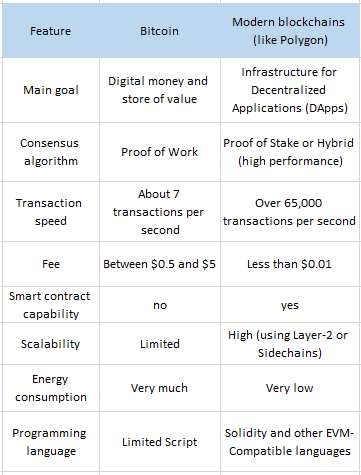
🔹 4. Technical comparison of Bitcoin and modern blockchains
When it comes to cryptocurrencies and new financial technologies, two words are thrown around more than anything else: Bitcoin and Blockchain.
At first glance, many people think of the two as the same thing, but in reality, Bitcoin is just one application of blockchain technology — just like email is just one application of the Internet.
To understand more accurately, we need to know how each came to be, how they work, and what the relationship is between them.
🔹 1. The emergence of blockchain and Bitcoin
In 2008, a person or group using the pseudonym Satoshi Nakamoto published a paper titled “Bitcoin: A Peer-to-Peer Electronic Cash System.” This paper first introduced the concept we now call “blockchain”—although the term was not officially used at the time.
Satoshi’s initial goal was simple but revolutionary:
Creating a digital monetary system that can transfer value directly between users without the need for banks or intermediaries.
To achieve this goal, he had to design a system that:
- Protect transaction data (cryptographic security)
- Prevent double spending
- Be reliable without a central authority
His answer to all these challenges was what we now call the Bitcoin blockchain — a chain of encrypted blocks that stores all transactions from the beginning to the present day and is distributed among thousands of independent nodes.
🔹 2. What is Bitcoin?
Bitcoin (BTC) is the world’s first cryptocurrency and the first real-world application of blockchain technology.
The network uses the Proof of Work algorithm to allow nodes to agree on the validity of transactions.
On the Bitcoin network:
- Each node maintains a copy of the ledger;
- Miners use their computing power to solve cryptographic equations;
- The first miner to find the correct answer is allowed to add the new block to the chain;
- In return, he receives a reward in the form of new Bitcoin.
That’s why Bitcoin is both a digital currency and a decentralized payment network.
🔹 3. What is blockchain?
Blockchain, at a higher level, is the underlying technology that enables Bitcoin to function.
But contrary to popular belief, blockchain is not limited to Bitcoin.
In fact, blockchain can be defined as a type of distributed ledger in which information is stored in a chain of blocks. Each block contains a set of transactions that become immutable once verified by the network.
After the success of Bitcoin, developers realized that the technology could be used in areas beyond digital money — from smart contracts to electronic voting, supply chains, and digital assets.
As a result, the second and third generation of blockchains were formed:
- Ethereum with the ability to execute smart contracts
- Polygon aims to increase speed and reduce fees
- And dozens of other networks, each offering a version of the same basic Bitcoin idea with more advanced features.
🔹 4. Technical comparison of Bitcoin and modern blockchains
As the table shows, Bitcoin, as the first generation of blockchains, relies on absolute decentralization and high security, while new-generation blockchains like Polygon seek to balance speed, security, and scalability.
🔹 5. The relationship between Bitcoin and Blockchain
Bitcoin is the first successful application of blockchain, and without it, there probably wouldn’t be anything called Web3 today.
But from a technical point of view, the relationship between the two is as follows:
- Blockchain is infrastructure.
- Bitcoin is one specific implementation of that infrastructure.
- Every new cryptocurrency or network (like Polygon or OmidCoin) uses the same basic concept, but with changes in architecture, consensus algorithm, or economic model.
In other words:
Bitcoin is built on blockchain, but blockchain is not limited to Bitcoin.
This is the fundamental distinction that changed the course of technological evolution from “digital money” to “decentralized economy.”
🔹 6. Bitcoin’s limitations and the motivation for the birth of networks like Polygon
Although Bitcoin initiated the digital revolution, its inherent limitations led to the emergence of a new generation of blockchains:
- Slow transaction speed: Bitcoin only processes about 7 transactions per second, while the market demand is much higher.
- High fees: During times of network congestion, transfer fees can reach several dollars.
- Lack of smart contracts: The Bitcoin network is designed only for value transfer and does not have the ability to execute programming logic.
- Extremely high energy consumption: The Proof of Work algorithm consumes a lot of electricity and is not environmentally sustainable.
To overcome these limitations, blockchains like Ethereum and then Polygon emerged to offer a new model of scalable, fast, and environmentally friendly networks.
🔹 7. Polygon’s role in the evolution of blockchain after Bitcoin
Polygon can be considered the “third generation of blockchains” — a network that combines the benefits of Bitcoin (security and transparency) and Ethereum (smart contracts), without sacrificing scalability and speed.
Using Layer 2 Scaling technology, Polygon complements Ethereum rather than competes with it. In essence, Polygon acts as a bridge between Bitcoin, Ethereum, and the real world, where transactions are fast, cheap, and secure.
In this ecosystem, OmidCoin, as a native token on the Polygon platform, benefits from all of these features — namely:
- Blockchain security and transparency
- Polygon Network Speed and Low Fees
- and suitable technical infrastructure for future expansion
🔹 8. Conclusion: Bitcoin is a gateway to the world of blockchain
If we compare blockchain to the internet, Bitcoin is the world’s first website — simple, limited, but revolutionary.
From this innovation, much more advanced networks like Ethereum and Polygon were born, which are now the basis for projects like OmidCoin.
In short:
- Bitcoin was the beginning of trust without intermediaries.
- Blockchain is the technology that made this trust possible.
- And Polygon has paved the way for a faster, greener, and more scalable future.
Therefore, OmidCoin is not only a part of blockchain history, but also a logical continuation of the evolution that began with Bitcoin and has reached the world of Web3 and the decentralized economy today.
*
In the world of blockchain, the word “token” is one of the most widely used and yet most ambiguous concepts. Many users consider cryptocurrency and token to be synonymous, but in fact there is an important difference between them.
Simply put, a token represents a type of digital asset that is created on top of an existing blockchain and can represent anything — from a cryptocurrency to voting rights, a share in a project, or even a digital art object.
🔹 1. Technical definition of token
From a technical perspective, a token is a smart contract that runs on a pre-existing blockchain (such as Ethereum or Polygon) and is responsible for managing the supply, transfer, and ownership of digital units.
Unlike cryptocurrencies like Bitcoin or Litecoin, which have their own independent blockchain, tokens use another blockchain infrastructure for security and transaction processing.
For example:
- The USDT (Tether) token is built on the Ethereum blockchain (ERC-20 standard).
- The OmidCoin token also runs on the Polygon blockchain and adheres to the same standard.
Simply put, tokens are guests of their host blockchain.
🔹 2. Difference between Coin and Token
At first glance, both may look similar, but the main difference is in their “infrastructure”:
Feature | (Coin) | (Token) |
Main network | Has its own blockchain (like Bitcoin or Ethereum) | It is built on another blockchain (such as Polygon or BNB Smart Chain) |
Main function | Payment method on its own network | Represents a specific asset or application in a project. |
Example | BTC، ETH، MATIC | USDT، SHIB، OMID |
Possibility of extraction | Yes (in some coins) | None (generated by smart contract) |
Network update | Requires consensus of all nodes | Adjustable through changes to the contract |
Therefore, OmidCoin is a “token,” not a “coin,” because it is built on the Polygon network and does not use its own proprietary blockchain.
🔹 3. Real-world applications of tokens
Tokens are not just financial instruments; they can be used in a wide range of economic, social, and technological applications. Here are some of the most important:
🪙 1. Payment Tokens
Tokens that are used like digital money to pay for goods and services.
Example: USDC, DAI, and OmidCoin (in fast, low-cost transactions).
🏦 2. Investment or Security Tokens
Representing ownership in a real asset or project shares, these tokens are usually subject to financial supervision.
Example: Tokens that represent shares in a company or property.
⚙️ 3. Utility Tokens
They are used to access services or products within an ecosystem.
For example, to pay transaction fees, purchase subscriptions, or vote on platforms.
Example: MATIC on Polygon Network or BNB on Binance Chain.
🧩 4. Governance Tokens
They give holders the right to vote in project decisions.
For example, in DAO (Decentralized Autonomous Organization) projects, token holders vote on future changes or developments.
Example: UNI (in Uniswap) or COMP (in Compound).
🖼️ 5. Non-Fungible Tokens (NFTs)
Represent ownership of a unique digital asset, such as artwork, music, or in-game items.
Example: Bored Ape Yacht Club or Polygon-based NFT tokens.
🔹 4. Main types of tokens from a technical perspective
In terms of Technical Standards, tokens are usually categorized based on their smart contract structure. In EVM-compatible networks (such as Ethereum and Polygon), there are three main standards:
1. ERC-20 (Fungible Tokens)
- The most common type of token on the Ethereum and Polygon blockchains
- Each unit is exactly the same as the other (like identical banknotes)
- Used for payments, staking, or liquidity
🔸 Example: OmidCoin, USDT, LINK
2. ERC-721 (Non-Fungible Tokens / NFTs)
- Each token is unique and has its own value.
- Used for digital artwork, virtual terrain, and game items.
🔸 Example: OpenSea Tokens, Decentraland Land Tokens
3. ERC-1155 (Hybrid/Multi-Token Standard)
- Allows multiple types of tokens (fungible and non-fungible) to be created in a single contract.
- It is very useful in games or platforms that have diverse assets.
🔸 Example: Enjin Coin Ecosystem
🔹 5. What is the process of creating a token?
Creating a token is usually done by writing and deploying a smart contract.
General construction steps include the following:
- Definition of Name, Symbol and Total Supply
- Setting the Owner Address
- Defining Events such as Transfer or Approval
- Deploying a contract on the network (like Polygon) by paying a small MATIC fee
- Network verification and listing in browsers like Polygonscan
The OmidCoin token follows exactly this process and is deployed on Polygon as an ERC-20 Token.
🔹 6. Benefits of using tokens
Tokens have significant advantages compared to traditional financial systems:
- Transparency: All transactions on the blockchain are visible and traceable.
- Decentralized: No single entity can control it.
- High speed and low cost: Transactions are completed in seconds and have low fees.
- Programmability: The behavior of tokens can be controlled with code (Smart Contracts).
- Composability: Tokens can be easily used on various exchanges, wallets, and DApps.
🔹 7. Challenges and limitations of tokens
Despite the many benefits, using tokens also has challenges:
- Severe price volatility in the cryptocurrency market
- Security issues in smart contracts
- Risk of losing private key
- The need for transparent rules and regulatory frameworks
Projects like OmidCoin minimize these risks by following Polygon security standards and auditing the contract.
🔹 8. The role of tokens in the Polygon ecosystem
Polygon is one of the most popular platforms for creating and hosting tokens because:
- Very low transaction fees
- Full compatibility with ERC-20 and EVM
- Support for Ethereum development tools
- Cross-Chain Interoperability
There are over 20,000 active tokens on the Polygon network — from large projects like Aavegotchi and QuickSwap to social and charitable tokens like OmidCoin.
🔹 9. OmidCoin’s position among various tokens
OmidCoin is designed as an ERC-20 utility token.
Its goal is to create a platform for fast, transparent, and low-fee payments on the Polygon platform.
Potential uses for OmidCoin include:
- Small and instant payments
- Use in charity and social projects
- Rewarding users on digital platforms
- Possibility of staking or participation in future project decisions
🔹 10. Conclusion
Tokens are the beating heart of the blockchain ecosystem — a means of representing value, ownership, access, or voting in a decentralized world.
If we consider blockchain as a platform, the token is the unit of life on that platform.
In the meantime, Polygon has provided a platform that makes it simple, fast, and inexpensive to create and use tokens for projects.
And it is in this platform that OmidCoin was born;
a token that, by leveraging the power of Polygon’s blockchain, has a mission to spread value, transparency, and hope in the digital space.
*
In the world of blockchain, a standard token means a fungible or non-fungible digital asset that is designed according to specific rules and protocols and is capable of interacting with various wallets, exchanges, and platforms.
The main goal of standardization is to ensure compatibility, security, transparency, and widespread usability.
Common token standards, such as ERC-20, ERC-721, and ERC-1155 on EVM-compatible networks, provide a set of defined rules and functions to ensure predictable token behavior.
🔹 1. Technical definition of standard token
A standard token should:
- Have a Total Supply function that specifies the total amount of tokens.
- Have a BalanceOf(address) function so that each user’s balance can be viewed.
- Have a Transfer(address, uint256) function to allow token transfer between users.
- Have an Approve(address, uint256) function so that users can authorize token transfers.
- Have an Allowance(address, address) function to determine the amount of transfer allowed by a third party.
Mint and Burn functions can also be added if you need the ability to create new tokens or burn tokens.
These functions ensure that the token is correctly recognized and usable in all wallets and exchanges that support the relevant standard.
🔹 2. Main technical specifications
A standard token usually has the following characteristics:
Parameter | Explanation |
Token Name | * |
Symbol / Ticker | * |
Standard | Standard used (ERC-20, ERC-721, ERC-1155) |
Total Supply | Total number of tokens |
Decimals | Number of decimal places to specify the smallest token unit |
Blockchain Network | The network on which the token is deployed |
Contract Type | Smart contract for token management |
Minting/Burning | Ability to create or burn tokens (if needed) |
🔹 3. The difference between a standard token and a non-standard token
Feature | Standard Token | Non-standard token |
Compatibility | Can be used in wallets and exchanges | Requires custom settings |
Security | Smart contract reviewed and tested | It may be vulnerable. |
| Adding new features is easy. | Changes can be problematic. | |
Transparency | Clear and predictable token behavior | Possibility of inconsistencies in transactions |
🔹 4. Common standards
- ERC-20 (Fungible Tokens)
- Fungible tokens, each unit is identical to another.
- Applications: Payment, Rewards, Staking, Liquidity.
- ERC-721 (Non-Fungible Tokens / NFTs)
- Each token is unique and has its own value.
- Applications: Digital artwork, game items, virtual terrains.
- ERC-1155 (Multi-Token Standard)
- A combination of fungible and non-fungible tokens in one contract.
- Applications: Digital games and platforms with diverse assets.
🔹 5. Economic characteristics of the standard token
A standard token should have a logical economic design in addition to its technical specifications:
- Total Supply
- The total supply must be specified and limited to prevent sudden inflation.
- A portion of the tokens can be reserved for a gradual or locked-in offering.
- Decimals
- Determining the smallest tradable unit, usually between 6 and 18.
- Symbol / Ticker
- Be short, distinct and recognizable.
- No special characters or excessive length.
- Distribution Plan
- Tokens should be distributed transparently among the team, community, development, and marketing.
🔹 6. Security and transparency
Security features of a standard token include:
- Time-Lock: To prevent sudden sales of team parts or important stocks.
- Burn Mechanism: Possibility to reduce supply to maintain long-term value.
- Contract Audit: Review by reputable security companies.
- Anti-Whale Protection: Transaction limits to prevent large investors from dominating.
- Blockchain Explorer Verification: Register and verify contracts in network browsers.
🔹 7. Acceptance in wallets and exchanges
For a standard token to be truly useful, it must be recognized by most wallets and exchanges.
Main admission steps:
- Wallet Integration: Official registration in popular wallets such as MetaMask, Trust Wallet, Coinbase Wallet.
- DEX Listings: Creating a liquidity pool on decentralized exchanges and enabling instant trading.
- CMC & CoinGecko Listing: Token registration with complete information and official whitepaper.
- Community Awareness: Transparent information to users to build trust.
🔹 8. Conclusion
A standard token is a combination of a well-organized technical architecture, logical economic specifications, security, and transparency.
Its key features include:
- Adherence to specific standards (such as ERC-20 or ERC-721)
- Ability to interact with wallets and exchanges
- Economical design with supply control and lockability
- High security and transparency of transactions
By adhering to these principles, the standard token can be used as a reliable, stable, and functional digital asset in the blockchain ecosystem.
*
The name of each token plays an important role in brand identity, market recognition, and attracting user trust.
The token name not only identifies the project and its goals, but also creates visual recognition and memorability in the minds of users.
In this project, the token name “Omid” has been chosen. This name directly aligns with the project’s mission to create social, economic, and motivational value.
🔹 Token symbol (Ticker)
A token’s ticker is a short, visual representation of its name on wallets, exchanges, and trading platforms.
In this project, the OMC token symbol has been chosen. This short, simple, and distinctive symbol is capable of being quickly identified in digital markets.
Visual symbol of the token
The token’s visual symbol is designed in the shape of a cheetah.
Reasons for choosing the cheetah as a visual symbol:
- Iran’s National Animal: The cheetah is known as the national symbol of Iran and has cultural and historical connections.
- Symbol of hope and progress: This animal represents hope, motivation, and the desire for progress for Iran.
- Distinctive visual identity: The cheetah design in the logo and token symbol creates a strong and recognizable visual identity.
This choice of visual symbol makes the token a valuable and lasting project, not only economically, but also from a cultural and social perspective.
🔹 Reason for naming
The name “Omid” was chosen by the developer, Shiraz Youth Hope Holding. The reasons for this choice are as follows:
- Semantic connection: The word “Omid” in Persian means hope, motivation, and positive outlook. These concepts reflect the core identity of the project.
- International Compatibility: It is also equivalent to Hope in English and is easily understood by a global audience. This feature makes the token suitable for international activities and attracting foreign investors.
- Marketing and brand identity: A short, simple, and meaningful name easily sticks in users’ minds and has the ability to create emotional connection and instant recognition.
🔹 The role of the developer company
Shiraz Youth Hope Holding Company, with the aim of developing and managing blockchain and cryptocurrency technology projects, is responsible for designing the name, symbol, and identity structure of the token.
The choice of name and visual symbol was made with a strategic approach to make the token recognizable and valuable in domestic and international markets.
🔹 Conclusion
The token name, symbol, and visual identity are a critical part of the project’s success.
- Token Name: Omid coin
- Symbol: OMC
- Visual symbol: Cheetah, the national symbol of Iran and hope for progress
- Reason for naming: Inspired by hope and positive outlook, with understandable international relevance
- Developer Company: Shiraz Youth Hope Holding
This design ensures that the token has a strong brand identity, marketing meaning and transparency, and remains recognizable and distinctive throughout all stages of development and user acquisition.
7. Purpose of this token
Every successful token in the blockchain world carries a great mission and vision, beyond a mere economic tool.
Tokens act as a bridge between investors, users, and developers, helping to realize the project’s ambitious goals.
The present token, with its intelligent design and advanced economic structure, has been introduced as a key tool for the realization of an unprecedented and massive project in Iran. A project that aims to develop and build the largest modern and sustainable village-city in Iran and the world.
🔹 Macro Token Goals
This token has goals beyond the realm of cryptocurrencies and serves as the main pillar of a massive development project:
- Creating modern and sustainable villages and cities
- Developing living and tourism environments designed with the highest modern standards and sustainable technologies.
- Creating living spaces with urban, cultural, commercial, and recreational facilities, while preserving the natural and historical charm of the areas.
- Attracting large international investors
- Providing a safe and transparent platform for long-term and small investments in the project.
- The possibility of participation of foreign and domestic investors to take advantage of an innovative economic opportunity.
- Attracting international tourists
- Creating modern tourism environments that combine culture, nature, and innovative infrastructure to provide a unique appeal to visitors.
- Transforming the village-city into a global destination that draws tourists to Iran to experience sustainable and modern urban life.
🔹 Initial investment and project infrastructure
Before any executive action, Shiraz Youth Hope Holding has purchased 400,000 square meters of land in a pleasant and historical area close to the city of Shiraz.
- These lands form the basis of the large-scale project and have a current value of at least $8 million.
- Initial plans have been prepared to create the world’s largest village-city in this area.
- This initial investment ensures the ability to start the project with economic security and a long-term perspective.
🔹 Development capacity and long-term perspective
One of the unique features of this project is its amazing expansion capacity. The modern village-city plan has the potential to expand up to 35,000,000 square meters of land.
This extensive development capability allows the project team to:
- Gradually develop the residential, commercial, recreational, and tourism sectors.
- Provide sufficient space to attract new investors and increase the value of the project.
- Create the largest and most modern sustainable village-city in Iran and the world.
This vision makes the token a vital economic tool for the realization of the project and invites investors to actively participate.
🔹 The role of tokens in achieving goals
The token is not only a financial instrument, but also a means to realize large development projects:
- Investment and economic participation: The token allows for micro and macro investments in the project.
- Financial transparency: Transactions and allocations are recorded on the blockchain, allowing for full monitoring of capital flows.
- Encourage active community participation: Token holders can participate in the development stages and decision-making of the project.
With this approach, the token creates a direct link between capital, development, and social value.
🔹 Historical and cultural value of the project
The choice of the project area near Shiraz and the historical regions of Iran has led to:
- The project should be a combination of nature, culture, and modern architecture.
- In addition to economic value, it should preserve a rich cultural and tourism identity.
- Invite domestic and foreign tourists to a unique experience of sustainable urban living.
This combination of historical, cultural, and modern value makes the project a unique example in the world.
🔹 Economic outlook and future of the project
With gradual expansion of up to 35,000,000 square meters of land, the project will allow for the creation of:
- Thousands of modern residential units
- Commercial and entertainment centers
- Cultural and educational spaces
- Tourism and hospitality infrastructure
This structure not only enables sustainable economic growth, but also stabilizes and increases the value of the token in the long term.
🔹 Reference to the official website
To view full details of the modern village-city plan, maps, development plans, and investment information, interested parties and investors can visit the official Omid Coin website.
This website includes detailed information about plots, architectural plans, project updates, and investment documentation.
🔹 Conclusion
The present token aims to:
- Developing the largest modern and sustainable village-city in Iran and the world
- Attracting large investors and international tourists
- Creating a transparent, sustainable and participatory economic infrastructure
The initial investment in 400,000 square meters of land and the ability to expand to 35,000,000 square meters has provided a solid foundation for achieving these goals.
This token is considered the main economic and participatory tool for project realization, capital attraction, and community participation in the world’s largest village-city.
To view more details and follow the implementation steps, be sure to visit the official Omidcoin website.
8. Free mining percentage
One of the attractive and innovative features of each token is the ability to mine a portion of the token for free for users and enthusiasts.
This process not only familiarizes people with the token and blockchain, but also creates an incentive for active participation in the project ecosystem.
🔹 Total supply and free mining rate
The total supply of the token is 85 billion units.
In order to attract user participation and introduce the token to the community, 8% of all tokens will be made available for free mining.
This means that 6.8 billion tokens can be obtained through the free mining process.
🔹 How to extract for free
Free token mining is done completely digitally and automatically:
- The mining bot on the official Omidcoin website is responsible for allocating tokens.
- Users can receive free tokens by performing certain activities on the website.
- This process is transparent and traceable, and all transactions are recorded on the blockchain.
With this method, anyone can receive a portion of the token and become familiar with the project without making an initial investment.
🔹 Free mining goals
- Attracting new users and investors
- Providing the opportunity to experience the token directly before making a real investment.
- Introduction to the project ecosystem
- By receiving the token, users become familiar with the blockchain structure and the uses of the token in the project.
- Promoting community participation and engagement
- Active users on the website and token ecosystem become part of the development and growth of the project.
🔹 Conclusion
- Total Supply: 85,000,000,000 units
- Percentage of free mining over four years (until 2030): 8% (6.8 billion units)
- Mining method: via the official Omidcoin website robot
- Goal: Introduce the token, attract users, and encourage active participation in the ecosystem
Free mining is one of the key methods for community development and increasing token adoption, and plays an important role in familiarizing users with the project and providing a real-world experience.
*
Introduction
Omidcoin’s economic model is designed to create a transparent, sustainable, and community-driven structure. By combining a gradual and controlled supply through a limited pre-sale and smart Proof-of-Activity mining, it maintains a balance between sustainable development, inflation control, and user incentivization.
In this structure, the development team is trying to make OMC one of the most stable digital assets on the Polygon platform, focusing on long-term resource management and increasing the intrinsic value of the token.
Case 1. Supply model objectives
* Maintain price stability and prevent sudden inflation
* Fair and community-oriented distribution
* Provide support for the development of sustainable infrastructure and projects
* Provide real incentives for users and long-term investors
Second item: Total supply and distribution structure (Distribution Plan)
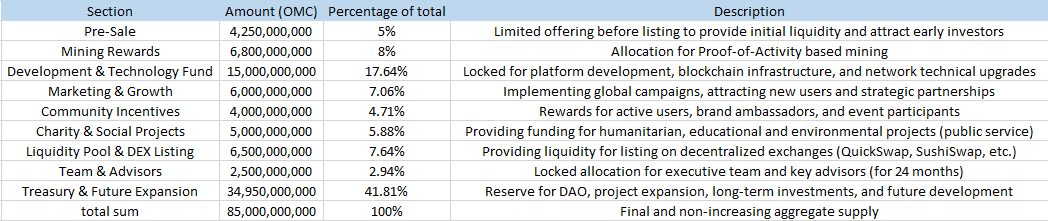
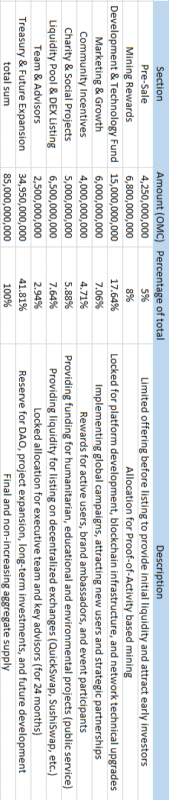
Please rotate your mobile phone if the table above is illegible.
Case 3. Mining Mechanism
The Omid Coin (OMC) mining system is designed in a hybrid, two-stage manner so that both ordinary users can mine tokens through simple interaction on the site, and more active individuals in the ecosystem can receive rewards through social participation.
This structure enables fair and true token distribution without the need for hardware equipment or technical knowledge.
🔹 First model: Mining via a website click-to-Mine Bot
This model is available through a dedicated mining robot on the official Omidcoin website. By logging into their account, users can mine tokens by performing manual clicks at specific time intervals.
The click system is designed based on the Proof of Click & Activity algorithm, meaning that each valid click is recorded as a sign of real user participation and its reward is calculated.
Features of the click model:
- Annual mining capacity: 1,700,000,000 OMC
- Project implementation period: 4 years (total 6.8 billion OMC)
- Requires manual click by user (no auto-run)
- Anti-fraud control and recording of valid clicks through the authentication system
- Automatic deposit of rewards into the wallet connected to the user’s account at the end of each period
This method allows users to earn a portion of the network mining and share in the profits of the token’s growth with the simplest possible action (clicking on the official site).
🔹 Second model: Community Activity Rewards
Alongside the clicker bot, 4 billion tokens are also allocated to active users in the Omidcoin ecosystem. This section is designed to encourage real participation in the project and operates through the Proof of Activity (PoA) algorithm.
Activities that include rewards:
- Long-term token holding in a personal wallet
- Performing on-chain transactions on the Polygon network
- Participation in events, charity campaigns, and social projects of hope
- Inviting new users through the official referral system
Specifications of the second model:
- Total capacity: 4,000,000,000 OMC
- Distribution period: 4 years
- Paying rewards on-chain via smart contract
- Complete transparency of transactions in PolygonScan
🔸 Mining Model Summary
Omidcoin’s mining model combines Click-to-Mine and Proof-of-Activity (PoA) structures to provide a unique, fair, fun, and transparent mining experience.
In total:
- Total mining share: 6.8 billion (clicks) + 4 billion (activity) = 10.8 billion OMC
- Total period: 4 years (from 2026 to 2030)
- Halving annual bonuses to preserve long-term value
- Full recording of transactions and rewards on the Polygon blockchain
Fourth item: Pre-Sale & Launch Strategy
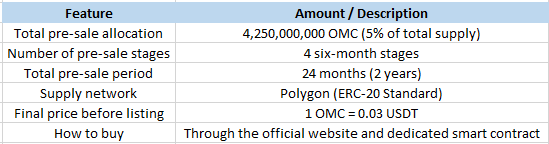
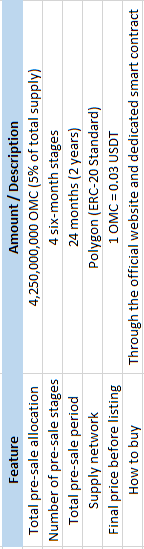
In order to provide initial liquidity, develop infrastructure, and expand the user community, 5% of the total supply (4,250,000,000 OMC) will be offered in a public pre-sale and phased over two years (from 2026 to 2028).
This phased structure helps balance the price, attract genuine investors, and prevent extreme volatility in the primary market.
🔹 General pre-sale details
🔸 Pricing structure and schedule of steps


Please rotate your mobile phone if the table above is illegible.
💰 Use of collected funds


🔸 Post-presale path
After the completion of the fourth phase of the pre-sale, the listing process on decentralized exchanges (DEX) will begin and the token will be listed on QuickSwap first. In the next stages, the listing program will be implemented on international centralized exchanges (CEX).
All pre-sale transactions and allocations will be visible and traceable via a verified smart contract in PolygonScan.
Item 5. Security and Transparency Features
* Time-Lock: Team, Treasury, and Development tokens are locked for at least 24 months.
* Burn Mechanism: 0.5% of each transaction is sent to an irreversible address.
* Audited Smart Contract: The smart contract is audited by reputable international companies such as CertiK.
*Anti-Whale Protection: Limiting transaction volume to prevent concentration of power.
*PolygonScan Verification: The contract address, logo, and official site link have been registered and verified.
Item 6. Wallets and public acceptance
- Wallet Integration: Supports MetaMask, Trust Wallet, Coinbase Wallet, and TokenPocket
- DEX Listings: Liquidity pool on QuickSwap, then SushiSwap and Uniswap
- CMC & CoinGecko Listing: Official Registration Information and Whitepaper
- Community Incentives: Hold & Earn campaigns for early adopters
- Partnerships: Collaboration with DeFi and NFT projects on the Polygon network
Item 7. Economic Goals & Inflation Control
The Omid Coin (OMC) offering model is designed to ensure that the actual market offering is only through stable and controlled channels.
These three channels include pre-sale in the first two years, click-through mining, and active user rewards.
The main goal is to create a balance between community growth, increasing token value, and preventing premature inflation.
📊 Omidcoin (OMC) Annual Active Supply Table


🔸 Sustainability policies and supply control
*Annual Halving of Rewards: The mining reward rate and user activity gradually decrease each year.
*Burn Mechanism: 0.5% of each transaction is burned to prevent inflation.
*Team and Development Lockdown: Team tokens, treasury, and future projects will be locked for 24 months.
*Smart liquidity management: Tokens are released on DEXs only in proportion to the actual market volume.
🪙 Economic conclusion
This delivery model allows for:
- The volume of tokens in circulation should grow naturally and logically.
- The market is safe from sudden supply pressure.
- The intrinsic value of OMC will increase over time.
In this way, Omid Coin (OMC) will be the founder of a new model of activity-based tokens and sustainable development on the Polygon platform, with a transparent, gradual, and community-oriented economy.
Item Eight: Technical-economic characteristics at a glance


Item 9. Conclusion
The Hope Coin token economy is a combination of economic engineering, supply discipline, and commitment to social goals.
With a controlled supply model, strong treasury support, and activity-based reward system, OMC is on track to become a stable, transparent, and community-driven digital asset.
*